
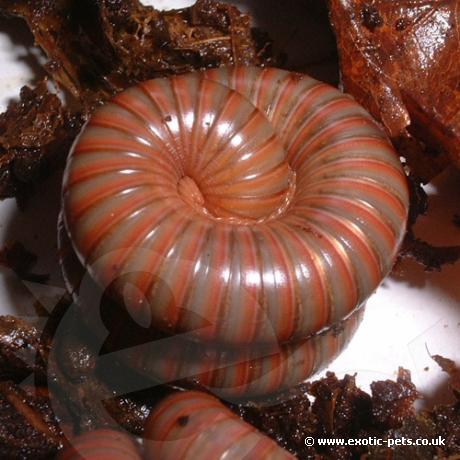
Burmese Millipedes are a great size when adult and have lovely colouring. This is an ideal pet for children who want an easy exotic pet, when out too much maintenance.
At a quick glance these millipedes look like they are a pinkish colour. Only on closer inspection can you see they are different colour strips on each segment. Each segment is a grayish colour and as this comes towards the end they are pink/orange. You can really see this when the curl up in to a spirle which seems to tower upwards. The grow to approx. 6-7 inches, which is a pretty large millipede!
replica handbags coach replica replica handbags gucci outlet Coach Outlet replica bags replica handbags replica handbags fifa 15 coins
Beneath stones and fallen timber in Burma.
Being a ground dweller, millipedes hide during the day under stones and fallen timber. They are active at night, when searching for foods. Provide a temperature of 20-26C (68-78.8F), room temperature will be fine. Spray half of the tank a few times a week to keep a humidity level of 60-75%. If the humidity is high enough, the millipedes may be seen during the day.
Yes, as long as you have the correct set-up.
You need to provide a group of Burmese Millipedes a tank space of at least 60x40x40cm. Place a layer of leaf matter on the bottom from trees of ash, maple, birch, beech or oak, alternatively use Irish Moss. The middle layer should consist of soil, best to use "John Innes Seed Compost". For the top layer, add more leaf matter with some rotting wood.
As already stated, millipedes eat leaf matter and rotting wood of the following trees; ash, maple, birch, beech and oak. They will also eat fibre-rich manure, vegetables, fruit, some raw potato, pasta, all manner of pet food and some occasional meat. Place a calcium supplement on the foods and remove any uneaten food preferably each day, to prevent mould.
Caution: Millipedes use a noxious chemical produced by lateral glands, if threatend. Depending on the species of millipede and person, this could have the following affects; it irritates skin, mucous membranes and eyes. The skin firstly turns yellow, then red or black, can cause blisters and in serious cases skin comes away leaving scarring. If this substance is spayed on your hands, wash immeditily with cold running water. The longer the millipedes are kept in captivity, the less tocix they become. If handled regular, they become use to this and don't feel threatend.