Home Page | About Exotic-Pets.co.uk New Feature | Contact Us | News, Offers & Events | Articles | Links | Refer and Earn Money
[ 31,752 members since September 2005 ]Welcome to Exotic-Pets.co.uk. Members sign in to access My Account. New to the site? Join here.

African Praying Mantis

African Praying Mantis
Click image for larger version

Sphodromantis belachowski, centralis, gastrica, lineola and vidiris

The African Praying Mantis is medium sized and typical mantis appearance. They range in shades of browns and greens depending on the species and humidity levels.


What does the African Praying Mantis look like?

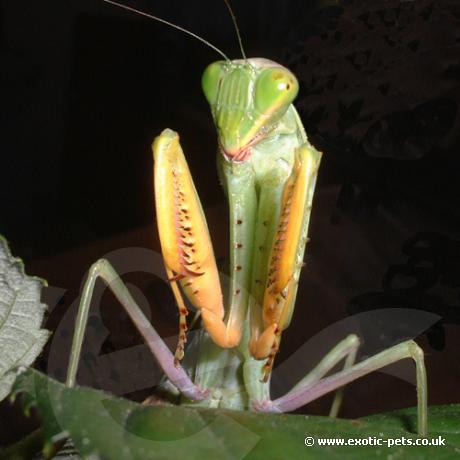
A typical praying mantis appearance with colours ranging from greens, brown and creams. Two small white or yellow coloured 'eyes' can be found on either side of their wing cases when adult.

Being a medium to large Mantis, the adult size varies from 60 - 80mm in length (Dependent on the species and sex). Both sexes are capably of flight when adults, but the female become to heavy with eggs that they mealy jump instead of flighing.

Where are African Praying Mantids from?

As the name suggests they can be found throughout most of Africa. All of these species are found here, just below the Sahara. So a relatively warm and dry environment, with a temperature of 24C (room temperature), and the humidity in the region of 50%, should be fine. Just spray, twice weekly to allow them to drink.

Sub Adult African Praying Mantis ready to strike at some food.

Sub Adult African Praying Mantis ready to strike at some food.

Are African Praying Mantids easy to keep?

YES, VERY EASY!!! This must be one of the easily obtained and hardest species you can come across. They are tolerant to the temperature and humidity irregularities, which could cause problems in other species.

Habitat for this mantis, is mainly shrub areas, through to forests. We suggest you use branches and false leaves for the mantis to lie in wait for its prey. But do not over crowd the cage too much, the mantis still needs space while shedding!

I would recommend that these are only kept together for a few months after hatching! Plenty of food must be provided as they are greedy when young! When they reach their 3rd shed, I would seperate them into their own living areas.


Research Do Your Research:  Before you commit to buying any pet, please do your own independent research.

*Want to know when stock is added/updated? Log-in for E-mail Notifications
Bookmark this page with:

Please Note: All sizes are approximate and should be used as a guideline only. Lizards are measured from snout to vent (excludes tail), therefore could be double the length listed.


Red Price - Loyalty Price
CB - Captive Bred - followed by year
CF - Captive Farmed - followed by year
CH - Captive Hatched - followed by year, Hatchlings from a Gravid Wild Collected Female.
WC - Wild Collected
LTC - Long Term Captive - in captivity for approx. 3 months+
1.1.5 - Sexed animals - Males, Females, Unsexed - eg. 1 Male, 1 Female, 5 Unsexed

On Site + Off Site About On Site and Off Site animals and items

Customers who bought the items above also bought:

Link to this page:
http://www.exotic-pets.co.uk/african-mantis.html

· Your access to and use of this Website is conditional on your acceptance of the Terms and Conditions of Use
© Exotic-Pets.co.uk 2005 - 2010 · Privacy Policy · Terms and Conditions of Sale